





My Son Sanctuary Private Tour: A Complete Guide

My Son Sanctuary private tour planning starts with understanding the place behind the ruins. At first, the valley appears to be a quiet collection of red-brick structures framed by forest. Look closer and the shapes begin to reveal an intricate sacred landscape: towers built for worship, carved details that communicate religious ideas, and surviving fragments that tell the story of the Champa kingdom. A private visit gives you the time to notice those layers, ask questions, and choose a pace that suits your interests.
This guide explains what makes My Son significant, what you can expect on site, how to plan a comfortable half-day visit, and how to decide whether a private tour is worth booking. It also helps you compare itineraries without assuming that every operator includes the same services. If you are staying in Hoi An or Da Nang and want more than a brief photo stop, use it as a starting point for a thoughtful trip.
What Is My Son Sanctuary?
My Son is a complex of Cham temple remains in a green valley in central Vietnam. It was associated with the religious life of the Champa kingdom over many centuries. UNESCO inscribed the sanctuary on the World Heritage List in 1999, recognizing both its evidence of cultural exchange and its importance for understanding Champa history. The surviving monuments reflect a local artistic tradition shaped in part by Indian Hindu ideas.
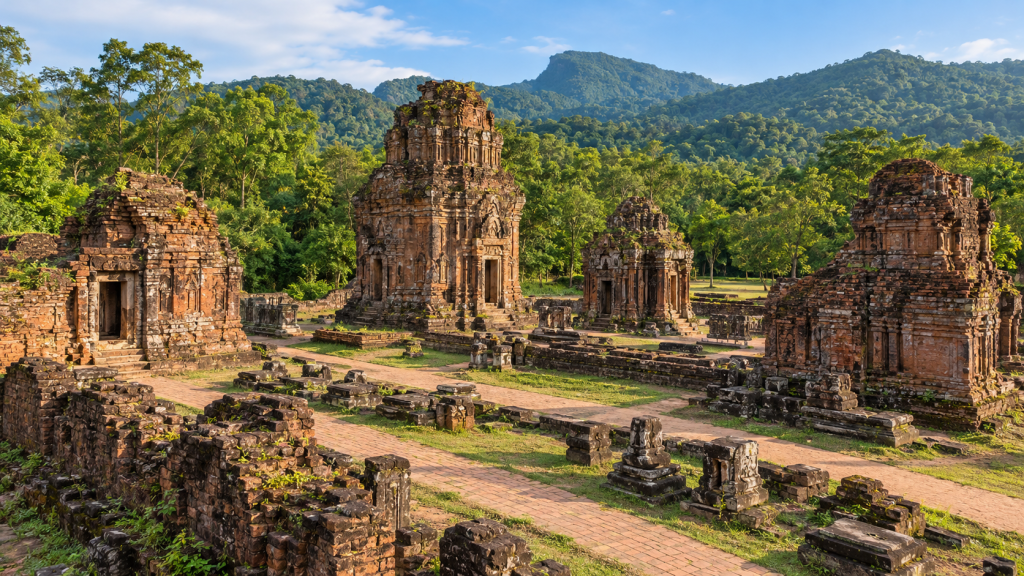
This is not a single temple with one entrance and one interior. It is a landscape of related groups, open spaces, architectural fragments, and paths. Some structures are comparatively intact; others survive as foundations or partly restored masonry. That variety is precisely why an informed visit matters. Without context, a broken wall can seem less interesting than a standing tower. With context, it can explain the original plan, a change in building style, or the work of conservation teams.
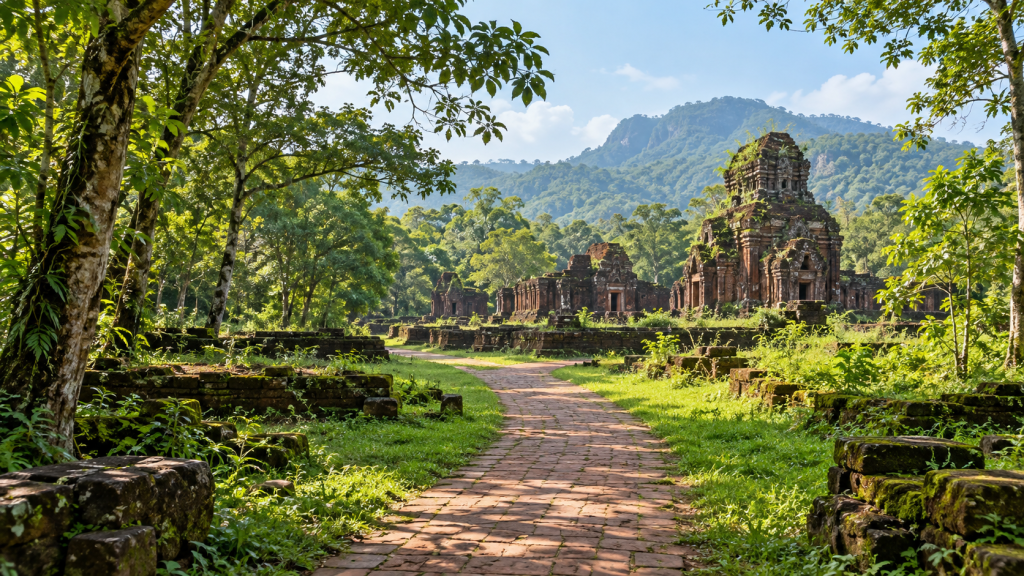
The sanctuary’s location also adds to the experience. Forested hills enclose the valley, giving the monuments a sense of separation from the traffic of coastal towns. The setting is beautiful, but it is a real archaeological site rather than a staged attraction. Expect weathered surfaces, active preservation needs, and routes that may change to protect vulnerable areas.
Why the Cham Temples Matter
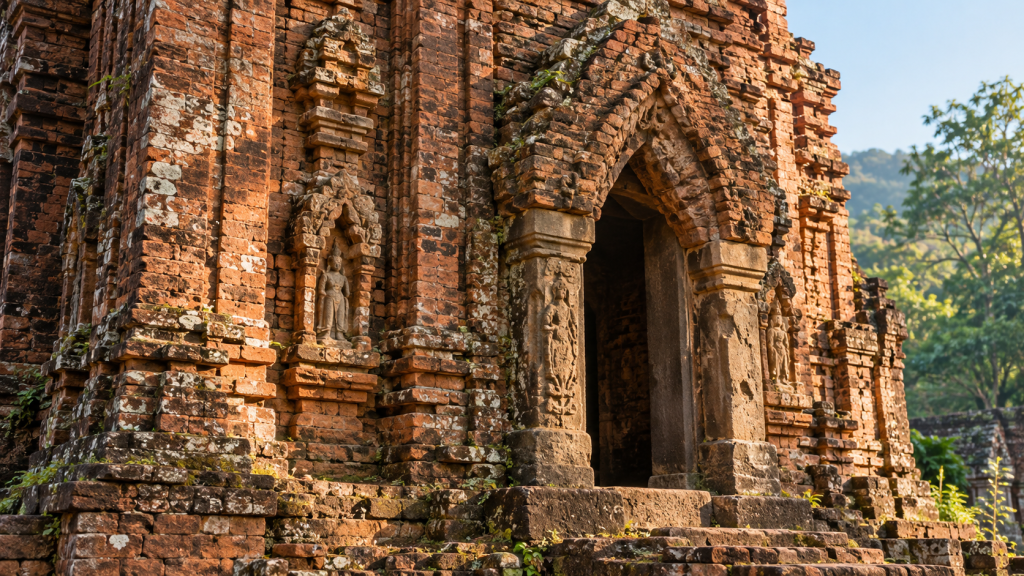
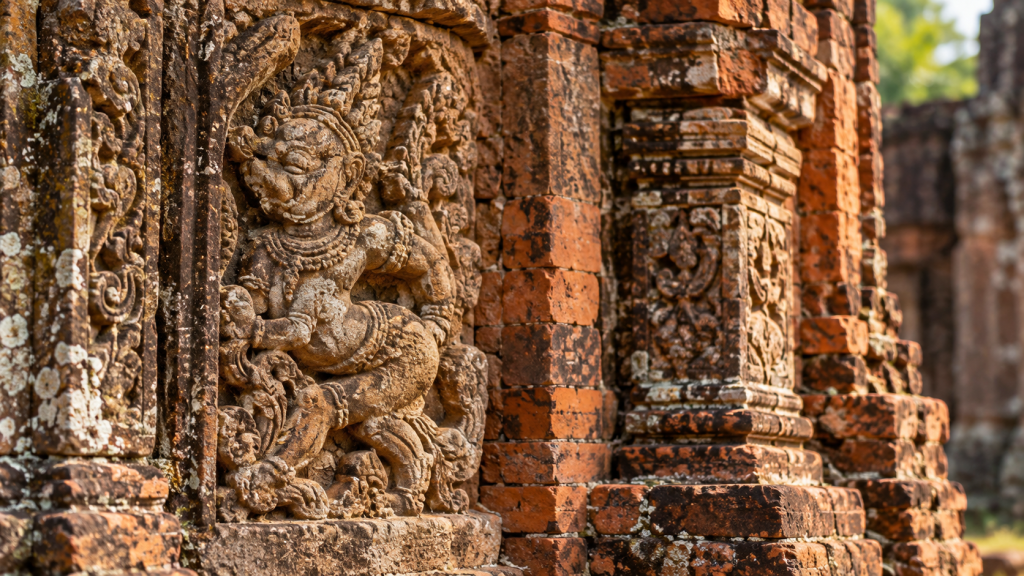
The red brick is usually the first detail visitors remember. The towers demonstrate the technical skill and visual language of Cham builders: carefully arranged masonry, strong vertical forms, and decorative features set into architectural surfaces. Sandstone elements and sculptural reliefs add another layer. Rather than looking for one instantly recognizable image, observe how a doorway, base, niche, and tower silhouette work together.
Many structures were connected with the worship of Shiva, a major Hindu deity. The sanctuary was also part of a wider network of political and spiritual relationships in the Champa kingdom. It helps to think of My Son as a place where rulers, religious practice, architecture, and artistic exchange met. A knowledgeable interpretation should explain these connections while distinguishing well-supported history from theories about damaged or missing parts of the site.
Different groups represent different periods and conditions. You may see an impressive standing structure, a smaller neighboring building, and low remains within a short walk. The contrasts show how the site developed and how unevenly it survived. War, climate, vegetation, and the ordinary passage of time all affected what you can see today. Conservation does not erase that history; it helps make the surviving evidence legible and stable for future visitors.
Before moving on, look at the relationship between brick and stone. Brick carries much of the architecture, while carved stone may articulate a doorway or a religious subject. You do not need to memorize every term to appreciate the design. Ask your guide to identify one clear example of each material and explain what is original, what has been stabilized, and what remains uncertain.
What a My Son Sanctuary Private Tour Should Include
A private tour is most valuable when the itinerary is designed around your questions and energy level. A good visit usually combines transport from your accommodation, time at the visitor facilities, a route through the principal accessible monument groups, and space to pause for photographs or discussion. The exact route depends on site access, conditions, and the interpretation you want. Ask for a realistic plan, not a promise to see every structure in a rushed hour.
The most important distinction is between private transport and private interpretation. A car with a driver can make the journey convenient, but the driver may not be a heritage specialist. A private guide may travel with you from town, or you may use an authorized interpreter at the site. Ask who will explain the monuments, what language they speak, and how much time is actually allocated for the guided walk. If deep history is your priority, these answers matter more than the vehicle model.
Check the inclusions before comparing prices. Is admission included? Is the guide or on-site interpretation fee included? Does the package cover hotel pickup and drop-off, water, and any stop beyond the sanctuary? Are there extra charges for pickup outside a stated zone? A lower advertised price can be perfectly reasonable, but only when you know exactly what it buys. Families should also confirm the child policy and whether their preferred pace can be accommodated.
A responsible operator should be comfortable explaining that monument access and cultural performances depend on the site’s current schedule and conditions. Avoid buying an itinerary solely because it promises a specific show or entry into every tower. The archaeological visit should remain worthwhile even if one part of the schedule changes.
Suggested Half-Day Itinerary From Hoi An
For many travelers, a half-day outing offers enough time to understand the core monument groups without turning the visit into a marathon. The official site places My Son roughly 45 kilometers from Hoi An; road time varies with pickup location, traffic, and weather. Plan the journey with a buffer instead of treating a map estimate as a guaranteed arrival time.
Start early if you prefer cooler walking conditions and softer light. After arriving, allow time to orient yourself at the entrance and museum rather than heading straight for the most photographed tower. The museum helps establish the broader history and gives names and images to details you will encounter outside. Use the site’s internal transport where operating, then continue along the designated visitor route with your guide.
Spend the central part of the visit exploring several accessible groups at a steady pace. Stop first for an overview of the valley, then compare buildings of different sizes and conditions. Make time for close observation of masonry and reliefs, while keeping a respectful distance from fragile surfaces. If a cultural performance aligns with your visit and is operating, it can be an additional experience rather than the reason to compress the archaeological walk.
On the return journey, a simple lunch stop can make the outing feel less hurried. Travelers who want a longer day can ask about an additional cultural or countryside stop, but check travel time before adding it. The best schedule leaves enough room for discovery. You should not feel that the guide is continually counting minutes until the vehicle leaves.
For a transport-focused planning guide, see our Hoi An to My Son Sanctuary article. When you are ready to compare an arranged experience, explore our My Son Sanctuary private tour page for the current itinerary and inclusions.
How to Read the Site Rather Than Just Photograph It
Begin with the setting. Notice how the monument groups sit within the valley and how open space separates buildings. Then look at a tower from bottom to top: base, entrance, body, and upper outline. From a distance, its silhouette feels simple. At closer range, small changes in brickwork, recesses, and carved details give it rhythm. A private guide can slow down at one building so you understand the pattern before moving to the next.
Ask what a visitor can actually know from the surviving material. Which feature identifies a sacred function? Which piece is a later conservation intervention? Why are some structures incomplete? An honest answer might sometimes be, “the evidence does not tell us.” That is a useful answer at an archaeological site. It keeps the story tied to what remains instead of filling gaps with attractive but unsupported legends.
Photography works best when it supports observation. Take a wider image to record the relationship between buildings, then a closer image of one material detail. Avoid climbing onto masonry or reaching across barriers for a better angle. The small marks made by many visitors can accumulate into significant damage. A meaningful collection of photographs should help you remember what you learned, not merely prove that you stood in front of a famous ruin.
If you enjoy cultural history, consider taking a few short notes after each group. Record one question, one detail you noticed, and one idea your guide explained. By the time you return to Hoi An, those notes will often be more valuable than dozens of similar tower photographs.
Private Tour or Independent Visit: Which Is Better?
An independent visit can work well for travelers who enjoy reading before they go, have their own transport arranged, and are comfortable setting a route on site. The sanctuary has visitor facilities, and you can decide how long to stay. This approach may also suit repeat visitors who already know the history and want quiet time with the architecture. You still need to check current opening information and plan the return journey.
A private tour makes more sense when time is limited, when you want historical interpretation tailored to your interests, or when the group has mixed needs. Parents may prefer flexible pauses; photographers may want more time at a particular viewpoint; history enthusiasts may want to compare specific temple groups. Private arrangements can also simplify pickup and the connection between transport and on-site time.
The word “private” alone does not guarantee a better experience. Ask how the guide prepares for the visit and whether the schedule allows questions. Check whether you will join any other group for a portion of the trip. If your goal is simply the lowest-cost transfer, say so. If your goal is an informed archaeological walk, make that equally clear before booking.
Practical Planning: Timing, Weather, Tickets, and Comfort
The climate can make a short walk feel longer than it looks on a map. Bring drinking water, sun protection, and comfortable shoes with grip. A light rain layer can be useful in unsettled weather. Some surfaces may be uneven or damp; tell the operator in advance if mobility is a concern so they can discuss the feasible route without promising access that the site cannot provide.
The sanctuary publishes its own visitor guidance, including admission, opening times, transport within the site, and performance information. These details can change. Check the official website shortly before departure, particularly during holidays or adverse weather, and confirm what your tour price includes. A performance time shown online should be treated as a plan to verify, not an unconditional guarantee.
Respect the place as both a visitor attraction and a heritage site. Follow signed routes and staff instructions, do not touch carvings or climb structures, and leave no litter. Dress comfortably and respectfully for a setting with a religious history. If a section is closed for conservation, view it from the permitted path. The point of a private visit is the freedom to learn at your own pace, within the limits that keep the site protected.
Questions to Ask Before Booking
First, ask for the total time from pickup to drop-off and the expected amount of time inside the sanctuary. A “half-day” label can hide a very short on-site visit. Second, confirm the exact interpretation arrangement: a guide traveling with you, an on-site interpreter, or an independent walk after a private transfer. Third, request an itemized list of admission, transport, guiding, water, food, and optional stops.
Ask whether the route can be adjusted for children, older travelers, a strong interest in architecture, or photography. Check the cancellation and weather policy and how the operator communicates changes to site access. If you want to see a cultural performance, ask whether its current schedule works with your preferred departure time. A clear operator will answer directly and tell you when a detail needs reconfirmation.
Finally, be specific about the experience you want. “I would like two unhurried hours among the monuments and a guide who can explain Cham architecture” is more useful than “show me everything.” A well-designed tour balances your interests with the practical realities of the valley. It should leave you with a clearer understanding of My Son, not just a checklist of photo stops.
Why My Son Deserves an Unhurried Visit
My Son is often squeezed into a morning because it is accessible from the coast. Yet its value is larger than the convenience of a half-day excursion. The site connects architecture, worship, political history, artistic exchange, and the ongoing work of conservation in one landscape. Its damaged and surviving structures belong to the same story. Spending time with both makes the visit more rewarding.
A thoughtful My Son Sanctuary private tour gives you a practical way to explore that story. Choose an itinerary with genuine interpretation, transparent inclusions, and enough on-site time to ask questions. Then let the valley unfold building by building. If you want a tailored route from Hoi An or Da Nang, review the current private tour details and confirm the latest site conditions before you travel.
Q&A — đặt sau bài chính
Is My Son Sanctuary worth visiting from Hoi An?
Yes, especially if Cham history, architecture, or cultural heritage interests you. Allow enough time at the monuments to understand the site rather than treating it as a quick photo stop.
How far is My Son Sanctuary from Hoi An?
The sanctuary’s official website gives a distance of approximately 45 kilometers from Hoi An. Driving time varies with your pickup point, traffic, and weather.
Do I need a guide for My Son Sanctuary?
You can visit independently. A knowledgeable guide or on-site interpreter can help explain the purpose of the buildings, the materials, and what is known about the surviving remains. Confirm the guiding arrangement before booking a private tour.
Does a private tour always include the entrance ticket?
No. Inclusions differ by operator. Ask whether admission, guiding, on-site transport, pickup, and any additional stops are included in the quoted price.
Can I see a Cham cultural performance during the visit?
The site publishes performance information, but schedules and outdoor arrangements can change with conditions. Check the current schedule before planning your departure around a show.
What should I bring?
Comfortable walking shoes, water, sun protection, and a light rain layer when needed. Follow designated paths and any temporary access instructions at the heritage site.


